
The 2026 U.S. Road Trip Safety Checklist: A Guide to Essential Car Maintenance & Driving Tips
A successful summer road trip usually comes down to a few simple things: a reliable vehicle, a prepared driver, and a plan that accounts for changing conditions. This guide brings those pieces together in one place. Read through it before you leave to stay ahead of the risks and keep your family safe every mile of the journey.
Home » The 2026 U.S. Road Trip Safety Checklist
- Road trips dominate: Roughly 9 out of 10 summer holiday travelers chose to drive rather than fly in 2025.
- Average summer trip spend: American households planned to spend around $3,471 on their longest summer trip in 2025.
- Roadside assistance calls: AAA responded to nearly 700,000 emergency calls during the 2024 July 4th week alone. Those calls often involved dead batteries, flat tires, lockouts, and empty gas tanks.
- Gas prices surge: Summer 2025 gas prices were the lowest since 2021, hovering near the 2024 average of $3.30 per gallon. Gas prices have skyrocketed approaching summer 2026—in mid-May, the national average hit $4.50 per gallon.
- Preventable risks drive many crashes: Speeding, distraction, and impairment are leading causes of summer traffic collisions.
- Preparation is key: You can reduce the risk of serious accidents or breakdowns before departure by inspecting your vehicle, performing maintenance, packing emergency preparedness equipment, and checking the route.
The Ultimate Road Trip Safety Checklist: A Summer Travel Guide for U.S. Drivers
Summer is the busiest driving season in the United States. Millions of families hit the road in droves, packing highways such as Interstate 80 and Route 66 with overwhelming volumes of vehicles.
Whether you’re traveling to a beach, a national park, a Minnesota lake cabin, or a far-away relative’s home, you’ll be encountering more chaotic driving conditions than usual this summer. This guide is designed to help you prepare for the realities of summer travel with current travel data, practical checklists, and useful safety tips.

By the Numbers: Summer Road Travel in America
Summer travel in 2025 set modern records. During Memorial Day Weekend alone, AAA projected that 45.1 million Americans would travel at least 50 miles from home, with 87% choosing road trips over flying.
Later, over the Fourth of July holiday period, AAA projected that 72.2 million Americans would travel the same distance. Of those, 61.6 million were projected to drive by car, which is the highest number ever recorded. These surges highlight just how much extra traffic hits the road during peak travel periods, elevating the risk of motor vehicle accidents.
Understanding the 100 Deadliest Days: Why Summer Driving Is So Dangerous
The “100 deadliest days” is a period spanning from Memorial Day to Labor Day, when fatal crashes surge across the United States. Several factors contribute to this seasonal increase. Schools are out, putting more inexperienced drivers on the road. Summer also brings more travel, late nights out, and a higher likelihood of impaired driving.
The data shows just how significant the risk is. During summer 2024, 10,438 people died on American roads. That’s an average of 113 deaths per day.
Teen drivers play a large role in this trend. In 2023, 2,897 people nationwide were killed in crashes involving a teen driver, and roughly one-third of those deaths occurred during the 100 deadliest days. On average, eight people are killed per day in teen-involved crashes during the summer, compared to seven per day throughout the rest of the year. Even more concerning, teen driver fatalities rose 17.2% over a two-year period, despite an overall decline in total summer traffic deaths.

Minnesota Snapshot
Minnesota has one of the lowest rates of summer traffic fatalities in the U.S., but the season still hits hard locally. Forty-one percent of the state’s traffic deaths occurred during the 100 deadliest days period in 2023. Minnesota reported 163 road deaths in summer 2023, which is one of the highest totals the state has seen over the last decade.
Certain summer holidays saw particularly large spikes in 2023. Minnesota had 436 total crashes on Memorial Day, 549 on July 4th, and 456 on Labor Day. Together, collisions on these three holidays led to 731 injuries and fatalities statewide.
Fortunately, there have been some recent improvements in Minnesota’s traffic safety. State officials reported that overall traffic deaths dropped 20% in 2025 due to enhanced enforcement and infrastructure investments. Total fatalities dropped from 475 in 2024 to 370 in 2025, resulting in the lowest number of traffic deaths in the state since 2019. Still, certain Minnesota roadways, including U.S. 169, I-94, I-35, U.S. 61, and U.S. 52, continue to pose a heightened risk during peak travel periods.
The Most Common Summer Accident Causes
Most summer crashes are tied to a small number of preventable factors. Data from the National Highway Traffic Safety Administration shows that driver decisions play a major role in serious accidents and injuries, including:

Distracted Driving: Cell phone use, eating, interacting with passengers, and other distracted driving behaviors claimed 3,208 lives in 2024. Texting while traveling at 55 mph is equivalent to driving the length of a football field with your eyes closed.

Speeding: Exceeding the speed limit was a factor in about 29% of all traffic fatalities nationwide in 2024.

Impaired Driving: Driving while under the influence of alcohol, cannabis, and certain prescription medications spikes during summer holidays.

Drowsy Driving: Drowsy driving contributes to roughly 100,000 crashes per year, and the risk is particularly high on long highway stretches.

Tire Failures and Blowouts: Hot pavement, combined with underinflated or worn tires, can cause a vehicle to spin out of control due to tire failure.

Construction Zones: Road work peaks during the summer and contributes to many rear-end collisions when drivers are unprepared to stop or change lanes.

Not Wearing a Seat Belt: About 48% of people killed in crashes in 2024 were not wearing a seat belt.
How To Prepare Your Car for a Road Trip: A 10-Point Safety Checklist
Most summer crashes are tied to a small number of preventable factors. Data from the National Highway Traffic Safety Administration shows that driver decisions play a major role in serious accidents and injuries, including:
- Check tire pressure and tread depth using the penny test.
- Inspect all fluids, including oil, coolant, brake, transmission, power steering, and washer fluid.
- Test all exterior lights, including headlights, brake lights, turn signals, and hazards.
- Check windshield wipers, and top off washer fluid.
- Test the air conditioning.
- Inspect the brakes—listen for squealing or grinding.
- Check battery age and terminals for corrosion. Most batteries last 3 to 5 years.
- Confirm that your registration, insurance card, and driver’s license are current.
- Check belts and hoses for cracks or soft spots.
- Schedule any overdue maintenance before the trip.

The Driver Safety Checklist: 9 Essential Rules for the Road
Safe driving habits matter just as much as vehicle preparation. Be sure to practice each of these every time you get behind the wheel:
- Check that all passengers are buckled—every seat, every time.
- Make sure all car seats are installed correctly and are appropriate for your child’s weight and height.
- Put your phone in “Do Not Disturb” or driving mode.
- Program your GPS route before you start driving so you can avoid having to adjust it on the road.
- Only drive when well-rested. If possible, avoid driving between midnight and 6 a.m.
- Don’t drive under the influence of alcohol, cannabis, or any impairing medications.
- Plan to stop for a rest break every 2 hours or 100 miles.
- Share your route and expected arrival time with someone at home.
- Review weather and construction alerts along your route, and plan accordingly. You can check 511mn.org for real-time Minnesota road updates.
How To Keep Your Teen Safe Behind the Wheel: The Complete Parent’s Checklist
Summer is the most dangerous time of the year for teen drivers, with more time on the road and more opportunities for risky behavior. As a parent, you can help your teen build safer driving habits from the start with these tips:
- Sign a written parent-teen driving agreement. Put expectations in writing to keep the rules clear and consistent.
- Go over Minnesota’s Graduated Driver Licensing requirements with your teen. Use them as a guide when establishing your driving rules.
- Restrict driving between 9 p.m. and 5 a.m., when the risk of a crash is higher.
- Limit the number of teen passengers, as additional riders increase the risk of distracted driving.
- Change your teen’s phone settings so notifications are automatically silenced while driving.
- Encourage your teen to only start driving once everyone in the vehicle is wearing their seat belt.
- Model safe driving behavior. Avoid speeding and phone use behind the wheel so your teen sees safe driving in practice.
- Have open conversations about the risk of impaired driving. Make sure your teen knows they can call you for a ride or use rideshare services when they don’t feel safe to drive.
How To Handle a Car Accident Away From Home: A Traveler’s Emergency Protocol
A car accident is stressful enough, and being far away from home can make everything more complicated. Here’s how to protect yourself in this situation:
- Check for injuries. Call 911 if anyone is hurt. Do not move seriously injured people unless there’s imminent danger.
- Move to safety. If the vehicles are drivable and no one is injured, move them out of traffic. Turn on your hazard lights.
- Call the police. Minnesota law requires you to report any crash resulting in injury, death, or more than $1,000 in property damage.
- Document everything. Photograph all involved vehicles, license plates, property damage, visible injuries, skid marks, road conditions, traffic signs, and the surrounding scene.
- Exchange information. Get names, phone numbers, driver’s license numbers, insurance carriers, policy numbers, and license plates from all drivers involved.
- Get witness contacts. If any third parties saw the crash, write down their names and contact details.
- Do not admit fault. Stick to the facts when speaking with police or other drivers.
- Seek medical attention. Some injuries, especially soft-tissue injuries and concussions, don’t show symptoms for 24 to 72 hours.
- Notify your insurance company promptly.
- Consult an attorney before giving recorded statements to the other driver’s insurer.

Final Pre-Departure Checklist
The morning of your trip is your last opportunity to make sure everything is in place before you hit the road. Take a few minutes to run through these final steps to avoid delays, reduce stress, and set the stage for a safer journey:
- Fuel tank full
- Phones fully charged
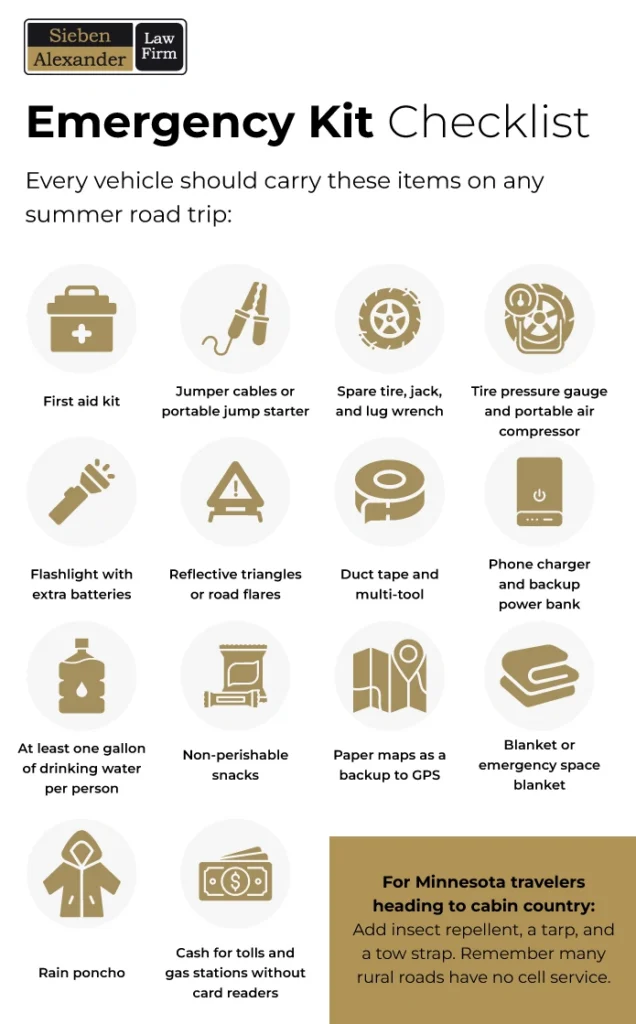
- Emergency kit in the vehicle
- Route reviewed, alternates identified
- Weather checked along the entire route
- Kids, pets, and cargo secured
- Everyone buckled in before putting the car in drive
Summer road trips are one of America’s greatest traditions. With thoughtful preparation, you can focus less on what might go wrong and more on enjoying the drive. Safe travels!

This guide is provided as a public safety resource by Sieben Alexander, P.A. Data sources: AAA, AAA Foundation for Traffic Safety, NHTSA, MnDOT, Minnesota Department of Public Safety. Statistics reflect the most recent data available as of 2026.

We provide a complimentary initial consultation for all mesothelioma and personal injury claims. Email us now or call 651-437-3148